
What Is Drone Mapping Used For?
Drone mapping is not aerial photography with a different name. A photograph is something you look at; a map is something you measure. The difference lives in how the flight is planned and how the images are processed afterward.
How a map is different from a photo
A mapping flight runs a fixed grid at a fixed altitude, firing the shutter on an interval so that every image overlaps its neighbors by roughly 70 to 80 percent. That redundancy is the whole point. Photogrammetry software finds features that appear in multiple frames, solves where the camera was for each shot, and reconstructs the scene as a dense cloud of three-dimensional points.
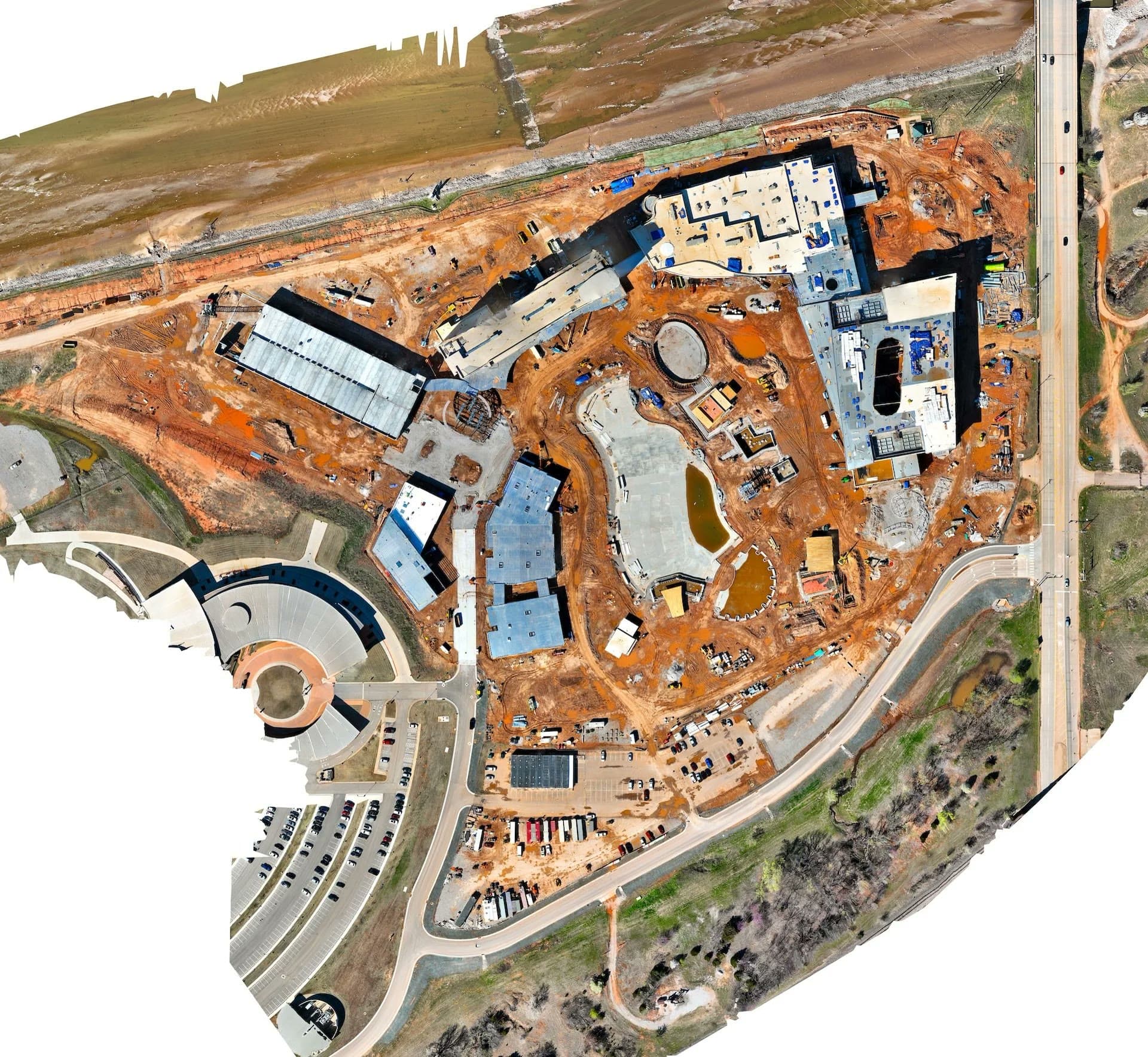
Once the geometry is solved, the software can flatten that reconstruction into a single top-down image with consistent scale across the entire frame. That is an orthomosaic, and it is the deliverable most people mean when they say drone map. Unlike a normal aerial photo, where objects near the edges lean away from the center, an orthomosaic can be measured anywhere on the sheet.
The four deliverables that come out of a mapping flight
Most mapping projects produce some combination of the following, from the same set of images:
- Orthomosaic — a scaled, measurable top-down image of the site, usually delivered as a GeoTIFF that drops straight into CAD or GIS.
- Digital elevation model — a surface of height values, used for drainage analysis, grading plans, and slope review.
- Point cloud — the raw 3D reconstruction, exported for engineers who want to work with the geometry directly.
- Textured 3D mesh — a navigable model of the site, useful for stakeholder review and for showing conditions to people who do not read plan sets.
Where it actually gets used
Construction is the most common application. A monthly mapping flight gives a general contractor a dated, measurable record of the site: what was graded, what was poured, how much material sits in the stockpile. Volume calculations off a drone mapping flight take an afternoon rather than a crew day, and the same imagery doubles as documentation if a dispute comes up later.
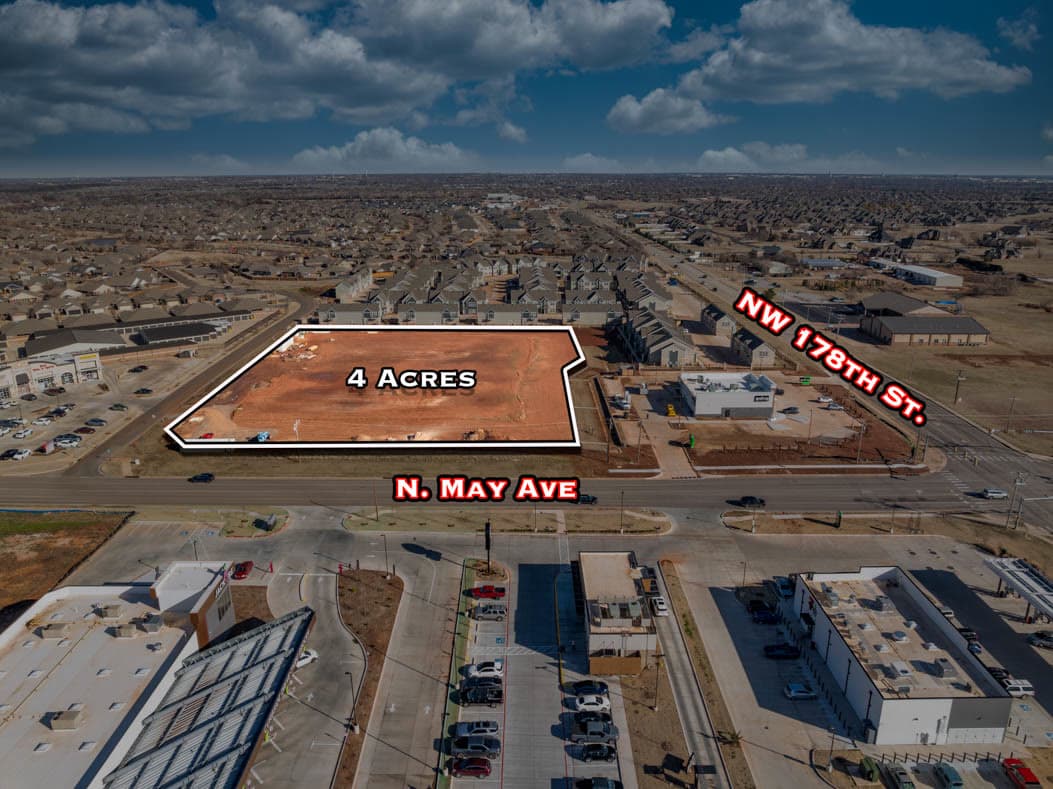
Land development and real estate use mapping earlier in the process, to understand a parcel before anything is designed. Boundary context, topography, existing drainage, tree cover, and access all read clearly off an orthomosaic and elevation model, and it is far cheaper to discover a problem at that stage than after design is underway.
Agriculture, solar, and utility corridors use mapping for coverage rather than measurement — flying a large area on a repeatable schedule and comparing one pass to the next. Municipalities use it for asset inventory and for documenting conditions before and after a storm.
What accuracy actually requires
Accuracy is where mapping projects succeed or fail, and it is worth being precise about the language. Relative accuracy — whether distances within the model are correct — comes out of good overlap and a decent camera. Absolute accuracy — whether a point in the model lands on the correct real-world coordinate — requires either surveyed ground control points placed across the site before the flight, or an RTK-enabled aircraft receiving live corrections from a base station or network.
Consumer drones with standard GPS place a model within several feet of truth. That is fine for a progress photo and useless for a grading plan. If a deliverable is going to a civil engineer, it needs ground control, RTK, or both, and the accuracy report should state the achieved figure rather than the theoretical one.
What a mapping flight involves on site
Planning happens before anyone drives out: the boundary is drawn, altitude and overlap are set for the required ground sample distance, and airspace is checked. Sites inside controlled airspace need authorization, which around Oklahoma City covers a considerable footprint between Will Rogers, Wiley Post, Tinker, and the smaller fields.
On site, ground control targets go down and get surveyed if the job calls for them, the grid is flown, and the images are validated before the crew leaves — a failed flight discovered back at the office costs a second mobilization. Processing runs afterward, and deliverables typically land within a few days depending on site size and what is being produced.