
What Drones Have Thermal Imaging?
Thermal drones have gone from specialist equipment to a normal line item on an enterprise fleet. The more useful question is no longer which drones have a thermal camera, but which have a thermal camera that produces data you can act on.
Radiometric or not — the distinction that matters
A non-radiometric thermal camera produces a picture. Warm areas are bright, cool areas are dark, and the scaling shifts as the scene changes. It is useful for spotting a person in a field or an obvious hot spot on a panel, and useless for anything requiring a number.
A radiometric sensor stores a calibrated temperature value for every pixel. You can open the file later, click any point, and read a temperature; you can set a threshold and have every pixel above it flagged; you can compare today's reading against last quarter's. Any inspection deliverable that will be handed to a client, an insurer, or an engineer needs radiometric capture. If a quote does not say radiometric, it is worth asking.
The platform tiers
Thermal-capable aircraft fall into three broad groups, and the gap between them is mostly sensor quality rather than the airframe:
- Prosumer thermal — compact folding aircraft with a modest thermal sensor alongside a visual camera. Genuinely useful for search, quick roof triage, and finding an obvious hot spot. Lower resolution means you must fly close.
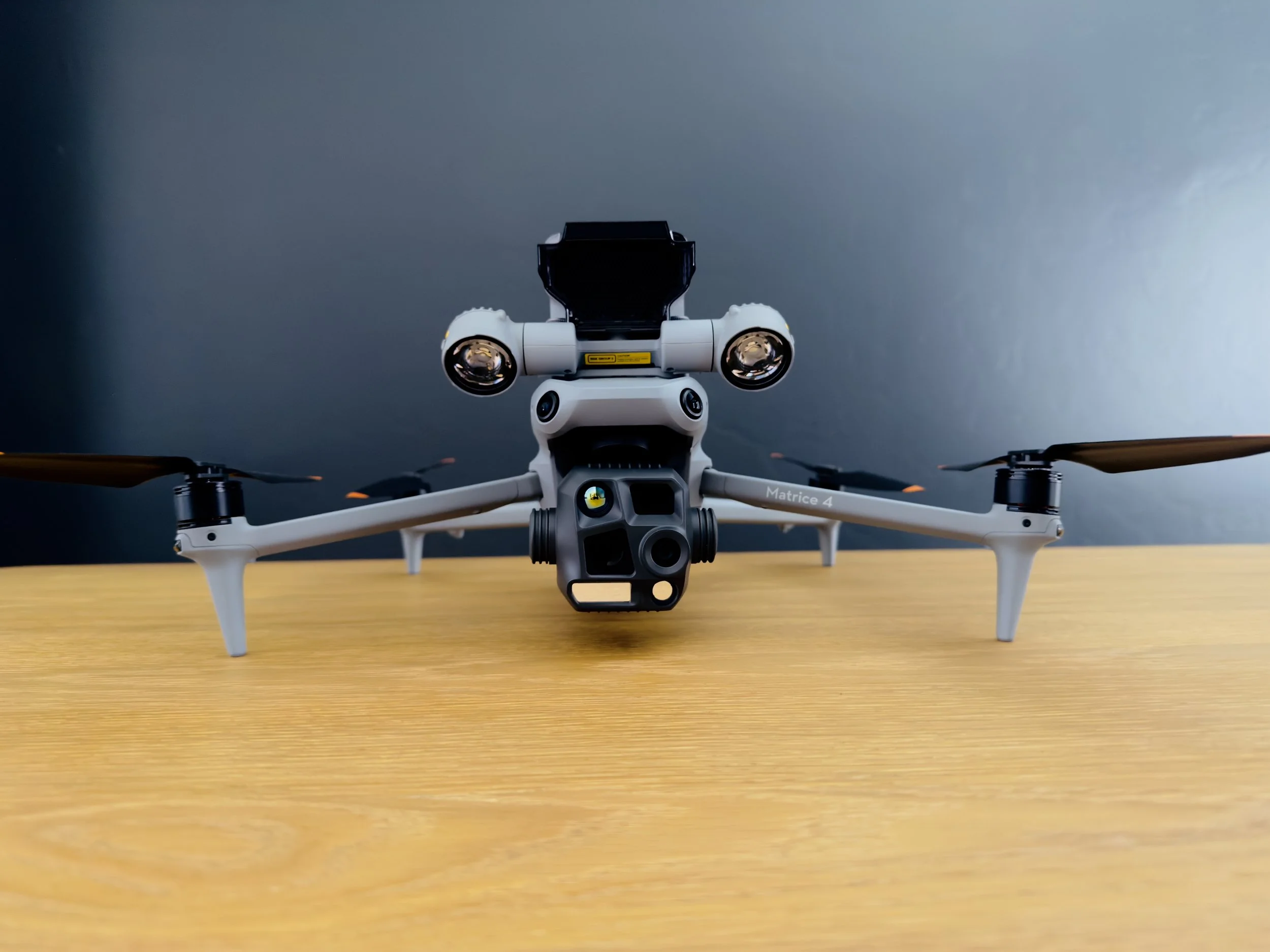
- Enterprise integrated — the working tier for commercial inspection. Higher-resolution radiometric sensors paired with a good visual camera and a strong zoom on a single gimbal, so visual and thermal are captured from the same position at the same moment.
- Payload-class platforms — larger airframes with interchangeable sensors, chosen when a job needs a specific scientific-grade sensor, longer endurance, or multiple payloads on one aircraft.
Resolution, and why it drives everything
Thermal sensors are dramatically lower resolution than visual ones. A drone that shoots 20 megapixels in daylight may carry a thermal sensor of 640 by 512 pixels — around a third of a megapixel. That is normal, and it is the constraint that shapes thermal flight planning.
Low resolution means each pixel covers more ground, so a defect smaller than a few pixels simply does not appear. The practical consequence is that thermal flights are flown lower and slower than visual ones, and a 640-class sensor covers an area far faster than a 320-class sensor because it can work from a greater standoff. On a large commercial roof or a full solar array, that difference decides whether the job takes one flight or four.
Conditions matter more than equipment
Thermal imaging detects differences in emitted infrared energy, which means it only works when a meaningful difference exists. That is a scheduling problem, not a hardware problem, and it is the most common reason a thermal scan comes back empty.
Roof moisture surveys need a clear day that loaded the roof with solar energy, followed by a scan in the hours after sunset while the wet areas are still releasing it. Building envelope work needs a temperature differential between inside and outside, which in Oklahoma means winter or the peak of summer, not a mild spring afternoon. Solar inspection needs strong irradiance, so it runs midday under clear sky. Search and rescue works best when ambient temperature is well below body temperature, which is why it favors night.
Rain, heavy dew, wet surfaces, and high wind all suppress or confuse the signal. A thermal flight scheduled for the operator's convenience rather than the physics is a wasted flight.
The certification nobody mentions
Owning a thermal drone and being able to interpret thermal data are separate skills. Infrared imagery is full of convincing artifacts — reflections off shiny surfaces, emissivity differences between materials that look like temperature differences, thermal shadows from something that moved an hour ago. Reading those correctly is a trained discipline with its own certification track, independent of the FAA Part 107 certificate that permits the flight.
When commissioning thermal work, it is reasonable to ask two separate questions: who is flying, and who is interpreting. The report is only as good as the second answer.